By Dr. Douglas Cowan, Psy.D., MFT
Every clinical conversation I have about anxiety eventually comes back to the same place. Not to the thoughts about the fear — to the structure underneath the thoughts. To the part of the brain that fires before conscious awareness, that does not speak in words or logic, that cannot be reasoned with but absolutely can be worked with.
The limbic system.
Understanding the limbic system does not cure anxiety. But it changes the relationship you have with your anxiety in ways that nothing else quite matches. When you understand what your brain is doing and why — when the experience that felt random and out of control reveals itself as a predictable neurological response to specific inputs — the fear of the fear begins to diminish. And that diminishment is itself the beginning of recovery.
What's Happening in the Brain
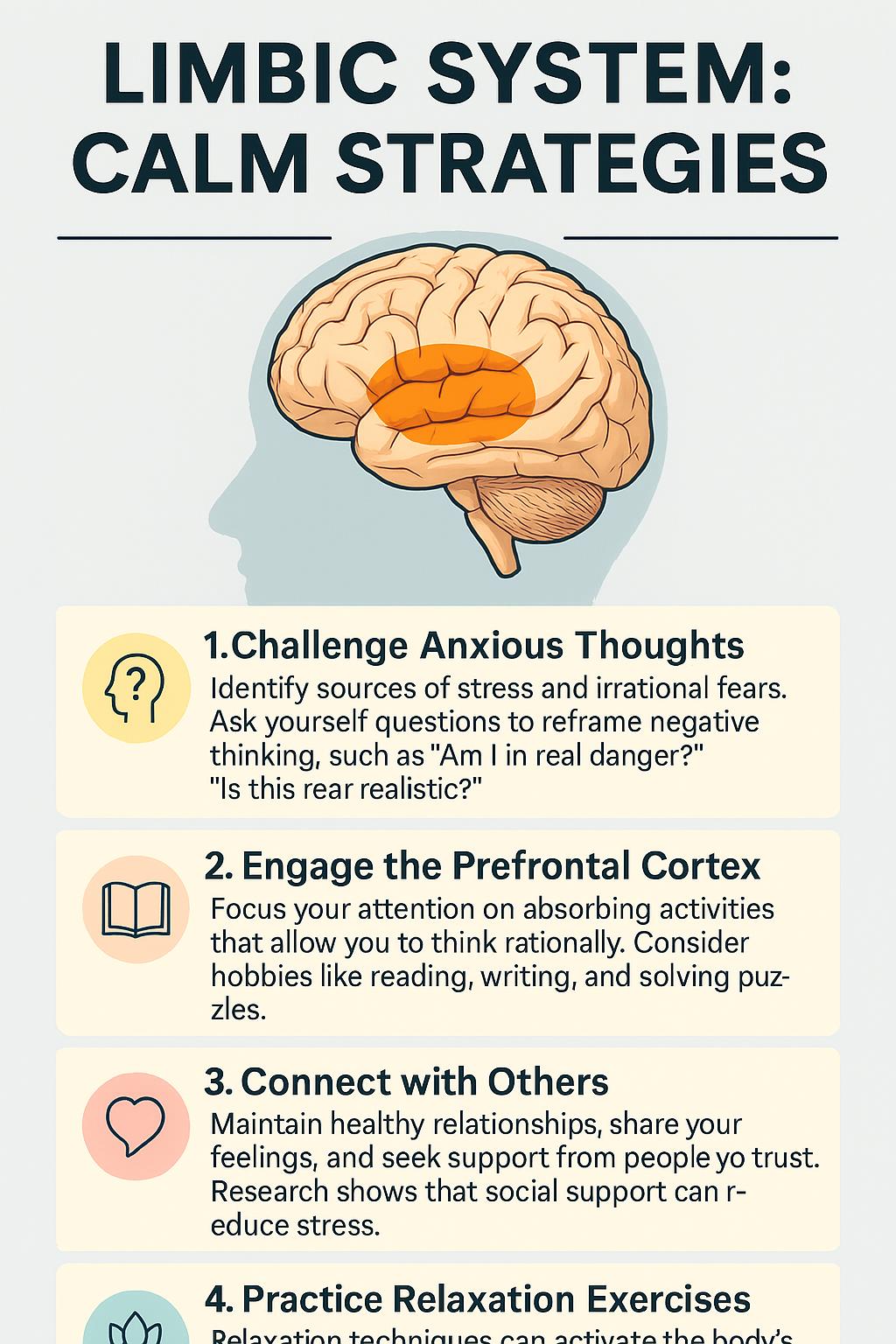
The limbic system is the brain's emotional processing network — a collection of deeply interconnected structures located beneath the cerebral cortex that evolved long before the rational, language-based, problem-solving cortex that we tend to think of as "the brain." It is ancient. It is fast. And it is designed for one primary purpose: survival.
The four structures most important for understanding anxiety are:
The amygdala is the alarm center — two small, almond-shaped clusters of neurons deep in the temporal lobe, one on each side. The amygdala's job is to continuously scan incoming sensory information for signs of possible threat and prepare the body to respond. It does this faster than conscious thought — milliseconds faster. By the time the thinking brain has assessed a situation and concluded that everything is fine, the amygdala has already fired, the stress hormones are already flooding the bloodstream, and the body is already in threat-response mode.
The amygdala does not distinguish reliably between a physical predator and a frightening thought. Between a genuine emergency and prolonged uncertainty. Between a real threat and an embarrassing memory that arrives suddenly at three in the morning. What it registers as danger, it treats as danger — regardless of what the cortex concludes.
The hippocampus is the brain's memory processor — responsible for forming and contextualizing long-term memories. It helps the amygdala evaluate whether a current experience is similar to past threats. When the hippocampus is functioning well, it provides context: "this situation resembles the dangerous one, but it is not the same situation." In PTSD and chronic stress, the hippocampus is impaired by sustained high cortisol levels — which is one reason traumatic memories feel present-tense rather than past-tense, and why generalized anxiety produces threat assessments in situations that are objectively safe.
The hypothalamus is the autonomic nervous system's command center — the structure that translates the amygdala's threat signal into a whole-body physiological response. It activates the HPA axis, releasing adrenaline and cortisol. It accelerates heart rate, shifts blood flow, tightens muscles, alters breathing, suppresses digestion. The hypothalamus is why anxiety is a whole-body experience, not just a mental one.
The thalamus is the brain's relay station — routing incoming sensory information to the appropriate processing areas. Crucially, there are two pathways by which sensory information can reach the amygdala: a fast, direct route from the thalamus that bypasses the cortex entirely, and a slower route through the cortex. The fast route is imprecise but immediate — it is why you flinch before you know what startled you. The slow route is more accurate but arrives too late to prevent the initial response. This architecture is why logic cannot stop the initial fear reaction. The amygdala has already acted before the logical brain received the information.
Now You Understand Why
This is why you can know you are safe — know it clearly, articulate it accurately — and still feel afraid. The fast thalamic pathway to the amygdala fired before your cortex had the information. The body is already in threat mode. Knowing is a cortex event. Feeling safe is a limbic event. They are different systems and they do not always update simultaneously.
This is why chronic stress physically changes the brain. Sustained high cortisol levels shrink the hippocampus, reducing its ability to contextualize fear and regulate the amygdala. They make the amygdala more reactive. They strengthen the neural pathways associated with threat and weaken those associated with calm. The longer anxiety goes unaddressed, the more the brain is physically shaped toward anxiety — not as a metaphor, but as measurable structural change.
This is also why the most effective anxiety interventions address the limbic system directly rather than only through the cortex. Talk therapy works primarily through the cortex. It changes the thoughts, the interpretations, the narrative. That is genuinely valuable. But if the amygdala is running at high activation, the cortex's reach into the limbic system is limited. Bottom-up interventions — breathing, physical grounding, neurofeedback, CES — calm the amygdala from below, creating the neurological conditions in which the cortex's top-down work can actually land.
What Wisdom Looks Like Here
The limbic system is not your enemy. It has kept you and every human before you alive. It is doing exactly what it was designed to do. The problem is that it was designed for an environment we no longer inhabit — one where threats were physical, immediate, and resolved quickly through action. Modern anxiety tends to be chronic, ambiguous, and unresolvable through fight or flight, which means the system stays activated long after its usefulness has ended.
Wisdom here is understanding that you cannot argue the limbic system into calm. You cannot think your way to a regulated amygdala. What you can do is speak the limbic system's language — safety signals delivered through the body, through rhythm, through sensation, through repeated experience of coming through the fear intact.
That is what all the regulation tools described across this site are doing. They are teaching the limbic system that it can come down. That the alarm does not need to run continuously. That safety is possible again.
What To Do Starting Today
- Use bottom-up tools first when the amygdala is active. When the alarm has fired and the body is activated — heart racing, chest tight, thoughts spiraling — logic is the least useful tool available. Slow breathing, grounding in the present moment, relaxing the jaw and shoulders, physical movement — these send the limbic system the signals it can receive. Start there. The cortex tools become far more effective once the amygdala has de-escalated.
- Use slow breathing to directly modulate the amygdala. The extended exhale activates the vagus nerve — the parasympathetic nervous system's primary pathway — and sends the amygdala a direct safety signal. The 4-4-6 pattern (inhale four, hold four, exhale six) and the supercharged sigh (double inhale, long forceful exhale) are both direct limbic interventions. Practice them daily when calm. You are building a reflex that the nervous system will access automatically over time.
- Understand that consistent regulation practice reshapes the brain. Neuroplasticity works in both directions. Chronic anxiety strengthens threat pathways and shrinks hippocampal volume. Consistent regulation practice — breathing, mindfulness, body-based grounding, therapeutic work — reverses these changes over time. The amygdala becomes less reactive. The hippocampus recovers function. The pathways for calm strengthen through use. This is not metaphor. It is documented neuroscience.
- Consider CES for direct limbic system support. The CES CalmBox stimulates the amygdala, hypothalamus, and brainstem directly through gentle microcurrent — the exact deep brain structures that regulate threat response and sleep. It reduces the background neural activation level that keeps the alarm running too hot. FDA-cleared for anxiety and insomnia. The calmer limbic baseline that CES produces creates the conditions in which every other intervention works more effectively.
- Consider direct neurofeedback for significant amygdala overactivation. Direct neurofeedback works by delivering brief subthreshold signals that disrupt the stuck high-activation patterns in the brain — lowering the volume in the amygdala and sympathetic nervous system while raising the volume in the parasympathetic system. It does not rely on learning or conscious participation. It allows the brain's own regulatory wisdom to reassert itself. For anxiety that has not responded adequately to other approaches, this is one of the most direct and effective neurological interventions available.
- Incorporate spiritual practices as genuine limbic resources. Prayer, gratitude, worship, and contemplation create experiences of safety, meaning, and connection — all of which activate the parasympathetic nervous system and calm the amygdala. This is not a secondary benefit of spiritual practice. It is a primary neurological mechanism. For people whose lives are anchored in faith, the spiritual dimension of anxiety recovery is not supplementary to the clinical work. It is woven through it.
- Work with a therapist who understands both the neuroscience and the person. The therapeutic relationship is itself a limbic intervention. A nervous system that has learned to feel safe in the presence of a calm, consistent, trustworthy person has gained an internal resource that generalizes into the rest of life. The relationship is not the backdrop for the clinical work. It is part of the clinical work.
The limbic system can be retrained. The amygdala can find a lower threshold. The pathways of calm can be strengthened until they become the default. This happens through patient, consistent, multimodal work — not overnight, but reliably, over time.
Everything is going to be okay. The door is open.