*By Dr. Douglas Cowan, Psy.D., MFT*
Search questions:
- How do I know if I have ADHD or if my child has ADHD?
- I keep forgetting things and can't finish anything — could that be ADHD?
You've wondered about it. Maybe for years.
You forget things you just decided thirty seconds ago. You start projects with genuine enthusiasm and abandon them before they're half done. You sit down to work and forty-five minutes later you're not sure where the time went or what you actually accomplished.
Or maybe it's your child. He can't sit still. She can't finish her homework. He knows the rules and breaks them anyway. She seems distracted by everything — or anxious about everything — or both.
The question keeps coming back: is this ADHD?
What's Happening in the Brain
ADHD is not a character flaw. It is not laziness. It is not poor parenting. It is a neurological condition involving the prefrontal cortex — the part of the brain responsible for attention, impulse control, planning, organization, and emotional regulation.
In people with ADHD, this system is underactive. The brain has trouble generating the internal motivation and focus needed to start and sustain tasks — unless those tasks are novel, urgent, or genuinely interesting. This is not a choice. This is neurology.
ADHD is also not one thing. There are at least five distinct profiles — the inattentive type, the hyperactive-impulsive type, the over-focused type, the anxious type, and the sluggish type — and each one looks different from the outside. This is why so many people go undiagnosed for years, especially adults, and especially women, whose symptoms tend to be quieter and easier to miss.
Now You Understand Why
This is why you can be genuinely intelligent, genuinely motivated, and still feel like your brain is working against you half the time.
This is why your child can look you in the eye and agree to do something and then walk into the next room and forget it completely. The attention system is simply not working the way it was designed to.
And this is why so many people with ADHD carry a quiet shame they can't quite name — the sense that they should be able to do what other people do, but they just can't seem to get there. That shame is not helpful, and it can stay in their hearts for years to come. The truth is simpler and much kinder: the brain needs better tools, not more willpower.
What Wisdom Looks Like Here
The wise first step is getting a real answer. Wondering in private costs you time and energy. A proper evaluation points toward real solutions.
What you're looking for is not a label. What you're looking for is an explanation — and with a good explanation comes a real path forward. ADHD is one of the most treatable neurological conditions we know of. People improve. Families improve. That is not wishful thinking. That is the clinical record.
What To Do Starting Today
- Start with our free ADHD inventory. Before scheduling an appointment or spending any money, take a few minutes to complete the free ADHD inventory we provide on this site. It is well-validated, it takes just a few minutes, and it will give you a much clearer picture of what you may be dealing with before you seek a formal evaluation. It is the right first step. [Link coming soon]
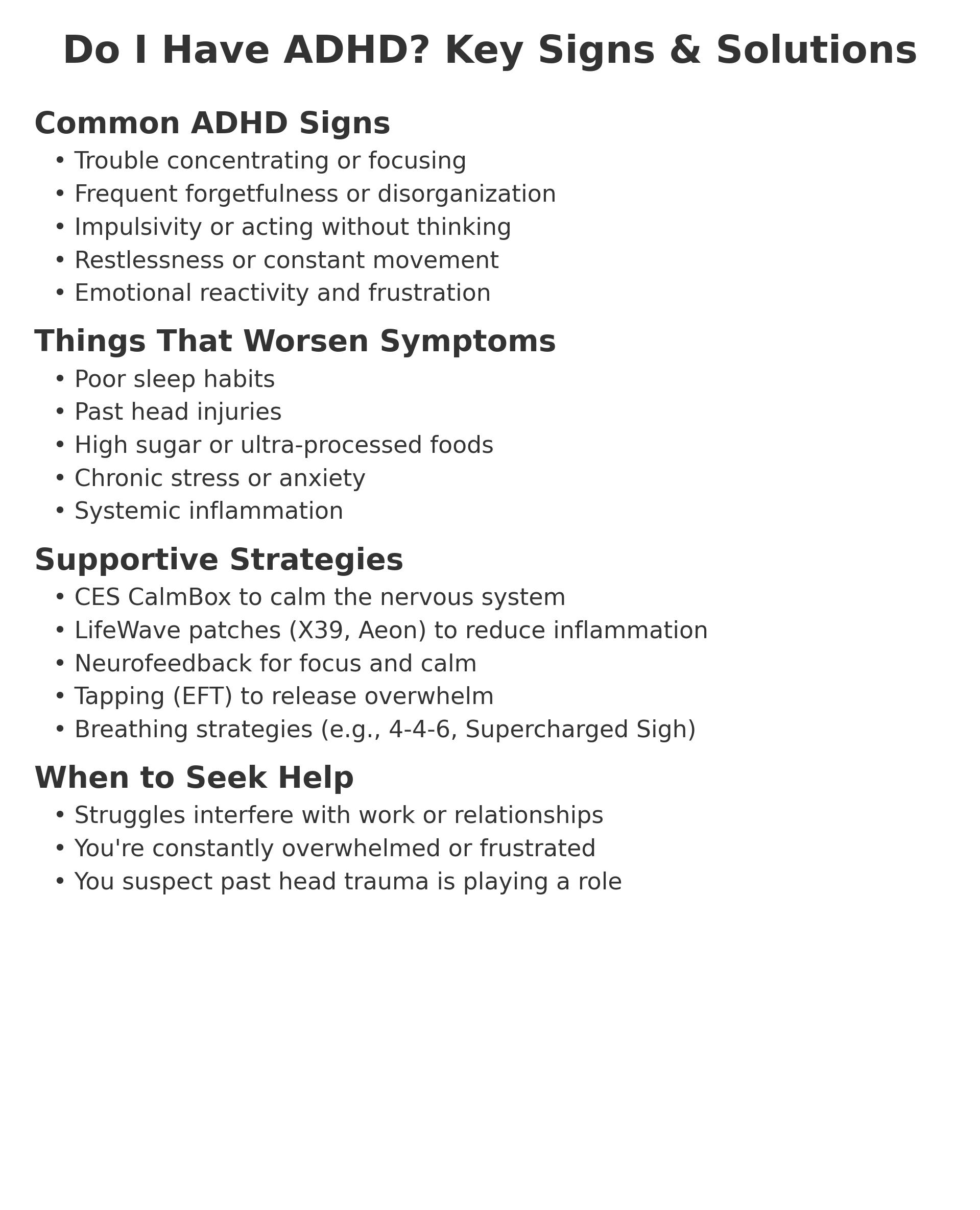
- Take an honest inventory of the symptoms. For children: does he struggle to stay on task, follow multi-step instructions, wait his turn, or stay seated? For adults: do you miss deadlines, lose things constantly, start far more than you finish, and feel emotionally flooded by things other people shrug off? A pattern across multiple settings — home, school, work — is the key signal.
- Seek a proper evaluation. A licensed psychologist, clinical social worker, or psychiatrist can evaluate ADHD thoroughly. A comprehensive evaluation looks at history, behavior across settings, cognitive performance, and rules out other conditions that can mimic ADHD — anxiety, sleep problems, trauma, and thyroid issues among them.
- Don't overlook contributing factors. Poor sleep mimics ADHD and worsens it. Chronic stress does too. So does a diet heavy in processed carbohydrates and sugar. Before or alongside any formal evaluation, take an honest look at sleep, nutrition, and stress levels.
- Consider working with a therapist or counselor who understands ADHD. Medication helps manage symptoms. A good therapist or counselor who knows ADHD teaches the skills — organization, emotional regulation, follow-through, and self-understanding — that medication alone cannot build. Coaching can also help, especially for adults managing work and daily demands. Skills are always going to be more important than pills.
- Know that treatment is not one-size-fits-all. Medication helps some people significantly. But medication is a tool, not the whole toolbox. Neurofeedback, CES, nutrition, exercise, counseling, and behavioral strategies all have strong track records. The best outcomes come from combining approaches tailored to the specific profile.
- Start somewhere. The worst outcome is continued wondering with no action taken. Take the inventory. Make one appointment. Have one honest conversation with a doctor you trust. That's the first step, and it's enough to start.
You are not broken. Neither is your child. You have a brain that works differently — and differently can be helped.
The door is open. Let's find the right tools to walk through it.
References
1. Barkley, R. A. (2015). *Attention-Deficit Hyperactivity Disorder: A Handbook for Diagnosis and Treatment* (4th ed.). Guilford Press.
2. Faraone, S. V., et al. (2021). The World Federation of ADHD International Consensus Statement. *Neuroscience & Biobehavioral Reviews, 128*, 789–818.
3. Kessler, R. C., et al. (2006). The prevalence and correlates of adult ADHD in the United States. *American Journal of Psychiatry, 163*(4), 716–723.
4. Quinn, P. O., & Madhoo, M. (2014). A review of attention-deficit/hyperactivity disorder in women and girls. *The Primary Care Companion for CNS Disorders, 16*(3).
5. Monastra, V. J., et al. (2005). Electroencephalographic biofeedback in the treatment of ADHD. *Applied Psychophysiology and Biofeedback, 30*(2), 95–114.