By Dr. Douglas Cowan, Psy.D., MFT
I have been using neurofeedback technologies in my clinical practice for over thirty-five years. I was among the early adopters of traditional EEG neurofeedback in the late 1980s, and I have watched the field evolve into the multiple technologies that exist today — including direct neurofeedback, which is the most significant advance I have seen in this space.
Most people who search for information about neurofeedback encounter a confusing mix of claims, technologies, and conflicting opinions. This article will cut through that confusion with a clear explanation of what neurofeedback actually is, how the two primary forms differ from each other in ways that matter clinically, and who each one is most likely to help.
The distinction I want you to understand — and that is almost never explained clearly — is this: traditional neurofeedback and direct neurofeedback are both genuinely effective, but they work through completely different mechanisms and are appropriate for different situations.
What's Happening in the Brain
Anxiety is not just a thinking problem or even primarily a chemical problem. It is an electrical problem. The brain runs on electrical activity — patterns of brainwaves that determine how activated or how regulated the nervous system is at any given moment.
In anxiety, specific brainwave patterns are dysregulated. The amygdala is overactive. The sympathetic nervous system — the fight-or-flight system — is running at elevated activation. The prefrontal cortex, which is supposed to evaluate incoming information and signal the amygdala when a situation is safe, is underperforming its regulatory role. The parasympathetic nervous system — the rest-and-recover system — is not adequately counterbalancing the sympathetic activation.
The result is a brain that cannot reliably downshift. It stays alert when alertness is not needed. It fires threat responses at low-threshold triggers. It cannot find and hold the regulated, calm, focused state that characterizes good nervous system function.
Neurofeedback — in both its forms — addresses this electrical dysregulation directly. Not through chemistry. Not through cognition. Through the brain's own electrical activity.
Now You Understand Why
This is why neurofeedback produces durable results in ways that medication often does not. Medication adjusts the chemical environment of the brain while it is active. When it is no longer active, the brain returns to its baseline. Neurofeedback changes the baseline itself — the patterns the brain defaults to — which is why benefits persist after treatment ends.
This is also why neurofeedback addresses anxiety at a level that purely cognitive approaches cannot reach as efficiently. Cognitive therapy changes the thoughts that ignite the amygdala. Neurofeedback changes the amygdala's reactivity threshold itself. Both are valuable. Together they are more powerful than either alone.
Traditional Neurofeedback — Learning Through Feedback
Traditional EEG neurofeedback is operant learning applied to the brain. Electrodes are placed on the scalp to measure the brain's electrical activity in real time. The client watches a screen — typically a video or a game — that responds to their brainwave patterns. When the brain produces the desired pattern, the video plays smoothly and a reward signal fires. When the brain drifts toward less desired patterns, the video pauses or dims.
Over repeated sessions — typically thirty to forty — the brain learns to produce the desired patterns more consistently. This is genuine learning. The prefrontal cortex is actively involved. The client is developing new self-regulatory capacity. The brain is practicing the skill of regulation in the same way a musician practices scales — with repetition building automaticity over time.
The results are real, durable, and supported by decades of research. Traditional neurofeedback has earned Level 1 evidence classification from the American Academy of Pediatrics for ADHD — the same level as medication — and has a substantial research base for anxiety as well.
The limitation is time. Thirty to forty sessions. Active participation required throughout. Children who cannot sustain attention and adults in acute distress find it more demanding.
Direct Neurofeedback — Optimizing Without Learning
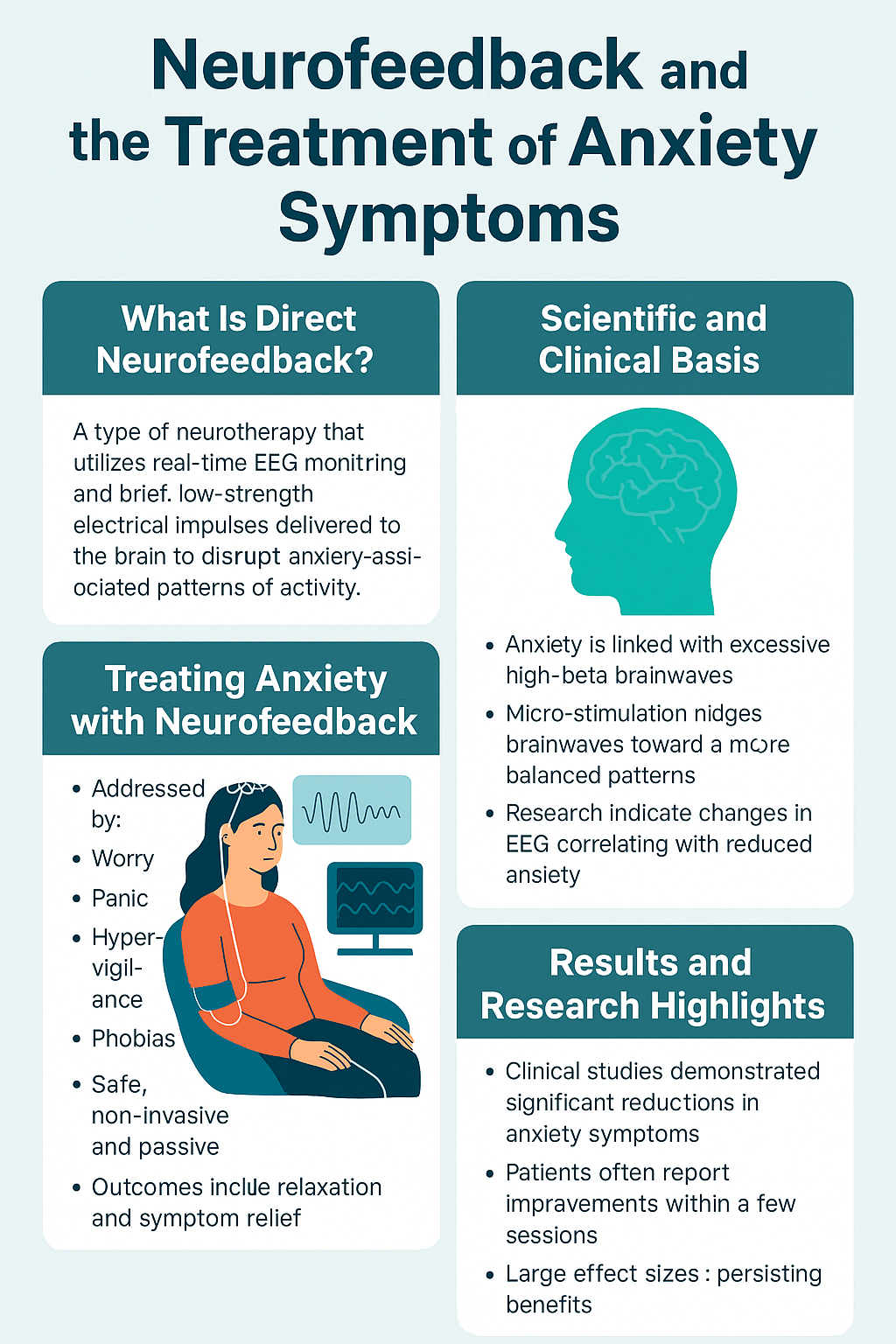
Direct neurofeedback — also called Low Energy Neurofeedback System (LENS), microcurrent neurofeedback, or IASIS — works through a completely different mechanism.
It does not rely on operant learning. The client does not watch a screen or train toward a target pattern. The client does nothing consciously at all.
Instead, the provider places electrodes on specific scalp locations. A subthreshold electromagnetic signal — far below what can be consciously felt — is delivered briefly to the brain. This signal is not designed to train the brain toward a specific pattern. It is designed to disrupt maladaptive, stuck patterns — the locked-in high-beta overactivation of the anxious brain, the frozen dysregulation of trauma, the rigid rhythms that have become entrenched through chronic stress.
The brain, receiving this gentle disruption, reorganizes. It uses its own neuroplasticity to find better-regulated patterns. Not because it has been taught a specific pattern — because it has been given the opportunity to reset from a stuck state.
The clinical effect: direct neurofeedback lowers the volume in the amygdala and the sympathetic nervous system. It raises the volume in the parasympathetic system — the peaceful, rest-and-recover system. Sessions are short — often twenty minutes or less. Many clients report meaningful improvement within the first five to ten sessions.
For trauma survivors, children, individuals in acute distress, and anyone for whom active participation in a forty-session protocol is not feasible, direct neurofeedback opens a door that traditional neurofeedback cannot as readily.
What Wisdom Looks Like Here
The question is not "which neurofeedback is better?" The question is "which neurofeedback is right for this person, at this time, for this presentation?"
Traditional neurofeedback is the right choice when the client can engage consistently over time, when the goal includes building active self-regulatory skills, and when the timeline of thirty to forty sessions is workable.
Direct neurofeedback is the right choice when the client needs faster relief, when active participation is limited by age, trauma state, or acute distress, or when previous approaches have not produced adequate results.
In my practice I use both, selected to the individual client. Many clients begin with direct neurofeedback to reduce the acute activation enough to engage effectively with the broader treatment plan, then transition to traditional neurofeedback to build the self-regulatory capacity that lasts a lifetime.
What To Do Starting Today
- Start with our free anxiety and ADHD inventory to identify your specific profile. Different anxiety profiles respond to different neurofeedback approaches.
- Seek a qualified neurofeedback provider for an assessment. Neurofeedback is not a self-administered technology. A trained provider assesses your specific brainwave patterns — ideally with qEEG mapping — and selects the protocol appropriate for your presentation.
- Expect a realistic timeline. Traditional neurofeedback typically produces meaningful change over thirty to forty sessions. Direct neurofeedback often produces earlier change — significant improvement within five to fifteen sessions for many clients.
- Combine neurofeedback with counseling for best outcomes. Neurofeedback changes the neurological foundation. Counseling builds the cognitive and behavioral skills on top of it.
- Consider CES alongside neurofeedback. CES addresses the same deep brain structures through a different mechanism. Many clients who use CES daily between neurofeedback sessions maintain lower activation throughout the week.
- Know that home-based neurofeedback options exist. Devices like Mendi, which trains blood flow regulation in the prefrontal cortex, are showing solid results for attention and anxiety regulation as a useful supplement between sessions.
Thirty-five years of clinical experience have given me a clear perspective: neurofeedback works. Both forms of it. It is not experimental. It is one of the most evidence-based, neurologically grounded interventions available for anxiety — and it produces durable results that medication and talk therapy alone frequently cannot match.
The brain can be trained. The alarm system can find a lower threshold. The parasympathetic system can learn to balance the sympathetic.
The door is open.