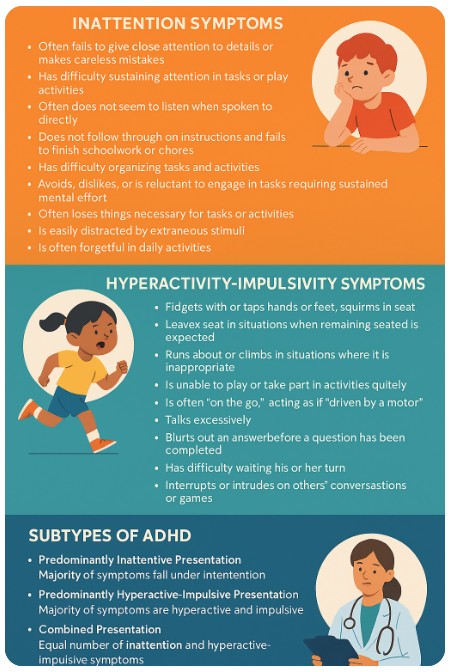
- What are all the symptoms of ADHD beyond just not paying attention?
- Why does my child seem to have ADHD but doesn't look hyperactive?
By Dr. Douglas Cowan, Psy.D., MFT
Most people think ADHD is about being hyperactive. Some know it can also mean being inattentive. Very few understand that ADHD is actually a five-part condition — and that without understanding all five parts, you will keep misreading what you're seeing and trying interventions that address only part of the problem.
About 11.4 percent of children in the United States — roughly one in nine — have been diagnosed with ADHD. Within that population, the presentation varies enormously. Some children are loud and visible. Some are quiet and easy to miss. All of them are dealing with some combination of the same five core symptoms, in different proportions and intensities.
What's Happening in the Brain
All five symptoms trace back to the same neurological source: the prefrontal cortex and its connected systems are underperforming. The brain's ability to regulate attention, manage impulses, tolerate boredom, track time, and hold working memory is impaired — not by choice, not by effort, but by neurology.
The dopamine system, which drives motivation and reward processing, is running low. The norepinephrine system, which supports alertness and sustained focus, is also insufficient. The result is a brain that is genuinely unable to do consistently what everyone around it expects it to do automatically.
Understanding this changes everything. These are not attitude problems. They are neurological ones.
Now You Understand Why
Once you know the five symptoms and what drives them, the behaviors that have been confusing or frustrating begin to make complete sense. He's not choosing to be difficult. She's not doing this on purpose. The brain is doing exactly what this kind of brain does — and with the right support, it can do considerably better.
What Wisdom Looks Like Here
The wisest response to each of these five symptoms is the same: stop increasing pressure and start building better systems. Pressure doesn't fix neurology. Structure, support, and the right tools do.
What To Do Starting Today
Symptom One — Inattention. The child who can play video games for two hours and cannot focus on homework for ten minutes is not being strategic. Video games are engineered to deliver constant dopamine — novelty, reward, stimulation every few seconds. Homework delivers none of that. The brain is not choosing one over the other. It is responding to what its chemistry can sustain. The practical answer is external structure — timers, checklists, movement breaks, shorter work intervals. Nutrition matters too: a high-protein breakfast fuels the dopamine system in ways a bowl of Captain Crunch simply cannot. Bacon and eggs beats cereal every time for this brain.
Symptom Two — Hyperactivity. In young children this is visible — constant movement, climbing, talking, bouncing. In older children and adults it often goes internal — a racing mind, an inability to relax, an urgency that drives overbooking and restlessness. The brain is seeking stimulation because its chemistry demands it. The answer is not to stop the movement but to channel it. Structured physical activity before demanding cognitive tasks raises dopamine and norepinephrine — the exact chemicals the brain is short on — and changes the trajectory of the next several hours. Martial arts, swimming, and sports that maintain constant movement are particularly well-suited for this profile.
Symptom Three — Impulsivity. The brain's prefrontal cortex is supposed to apply the brakes between an impulse and an action. In ADHD, those brakes are slow. The words are out before the thinking brain weighs in. The decision is made before the consequences are considered. This is not defiance. This is a delayed braking system. The practical answers are external rules that are practiced and rehearsed before the moment of impulse arrives, and consistent, patient coaching that builds new habits over time.
Symptom Four — Emotional Dysregulation. The emotional response in ADHD is faster, louder, and harder to recover from than in a neurotypical brain. This is not a mood disorder. It is the limbic system's emotional signal arriving before the prefrontal cortex can modulate it. Meltdowns over small frustrations, rage that seems disproportionate, euphoria that burns out quickly — all of these are the prefrontal cortex failing to regulate the limbic system's output. Neurofeedback directly addresses this pattern. Labels that stick — "he's just dramatic," "she overreacts to everything" — do real damage to a child who is already working harder than anyone realizes.
Symptom Five — Working Memory Deficits. Working memory is the brain's mental scratchpad — the ability to hold information just long enough to use it. Follow three-step instructions. Hold a thought while doing something else. Remember what you walked into the room to do. In ADHD, this system leaks. The practical answer is external memory — write it down, put it in front of the eyes, use a checklist. A three-by-five card with the morning routine on the bathroom mirror is not a crutch. It is a tool that compensates for a system that cannot hold the information reliably on its own.
All five of these symptoms are neurological. All five are addressable. Not perfectly, not overnight, not without consistent effort — but meaningfully, measurably, and with genuine hope.
That is where we start.
References
- Faraone, S. V., et al. (2021). The World Federation of ADHD International Consensus Statement. Neuroscience & Biobehavioral Reviews, 128, 789–818.
- Barkley, R. A. (2015). Attention-deficit hyperactivity disorder: A handbook for diagnosis and treatment (4th ed.). Guilford Press.
- Danielson, M. L., et al. (2024). ADHD prevalence among U.S. children and adolescents in 2022. Journal of Clinical Child & Adolescent Psychology, 53(3), 343–360.
- Wolff, N., et al. (2024). The dopamine hypothesis for ADHD. Frontiers in Psychiatry, 15, 1492126.
- Monastra, V. J., et al. (2005). Electroencephalographic biofeedback in the treatment of ADHD. Applied Psychophysiology and Biofeedback, 30(2), 95–114.
- Shaw, P., et al. (2007). ADHD is characterized by a delay in cortical maturation. Proceedings of the National Academy of Sciences, 104(49), 19649–19654.